Blog

Soft Skills in High School: What Employers Need
Over the past year, I sat down with business owners and leaders to ask a simple question: What do you need from the young people entering your workplace? They represented small family startups, midsize companies responsible for multiple brands and much larger organizations. They worked in blue-collar and white-collar fields. Their answers were remarkably consistent.
Too many students arrive from high school or college without the leadership and interpersonal skills needed to contribute well. They may have completed the coursework, but they struggle to communicate, take initiative, receive feedback, work with others or follow through. Soft skills in high school prepare students to communicate, take initiative, accept feedback, solve problems and follow through. The question for families is whether a school deliberately gives students enough opportunities to practice those habits before the stakes are higher.
What Employers Told Me About Student Readiness
The concern was not that young people lack intelligence or potential. Employers see plenty of both. The problem is that knowledge alone does not teach someone how to enter a room prepared, listen carefully, organize a project, respond constructively when corrected or take responsibility when something goes wrong.
Those conversations mirrored my own experience after more than 20 years in the corporate world. I worked for a Fortune 500 company, Cox Enterprises, as well as small venture-backed startups. Through research, marketing and product development roles, I served more industries than I can easily count. When I was responsible for hiring, I encountered the same gap: technical knowledge mattered, but the ability to communicate, collaborate and execute often determined whether someone could turn that knowledge into value.
Royalmont Academy is built to address that gap before graduation.
Soft Skills in High School Must Be Practiced
Soft skills are sometimes treated as personality traits—as though students either have them or they do not. In reality, many of the abilities employers value are habits that can be taught, practiced and strengthened:
- Communicating an idea clearly in speech and writing
- Taking initiative without waiting for every step to be assigned
- Planning work, meeting deadlines and following through
- Receiving feedback without becoming defensive
- Solving problems when the first approach does not work
- Working with people of different ages, strengths and perspectives
- Using personal gifts in service to a team and a larger purpose
Students do not develop these habits by reading a list about leadership. They develop them when real work requires preparation, judgment, revision and responsibility—and when trusted adults accompany them through that process.
Communication for a Real Audience
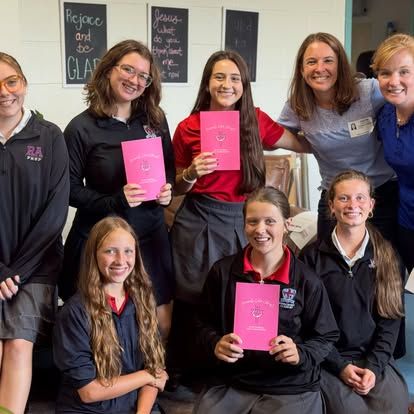
In Royalmont literature classes, high school students do more than analyze themes such as morality and identity. This fall, students prepared handwritten speeches for the Fall Banquet. That assignment asks them to organize their thoughts, choose language carefully and prepare to communicate before a real audience.
The audience changes the work. A student cannot hide behind a completed worksheet when other people need to understand the message. He or she must consider tone, clarity, preparation and delivery. Those same habits matter in a college seminar, a client conversation, a team meeting and a job interview.
Initiative, Ownership and Teamwork
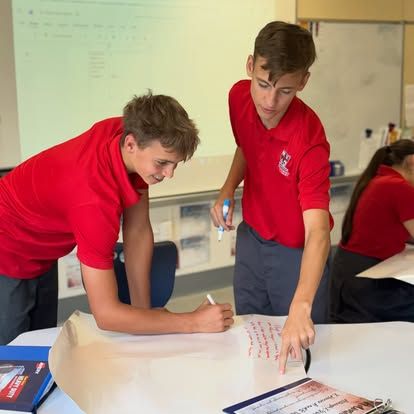
Students learn to turn ideas into plans, collaborate and take responsibility for the result.
Our Homecoming banner project offers another example. High school art students established the drafts and overall designs. Younger students then helped execute those plans. The older students’ work shaped what an entire group would produce.
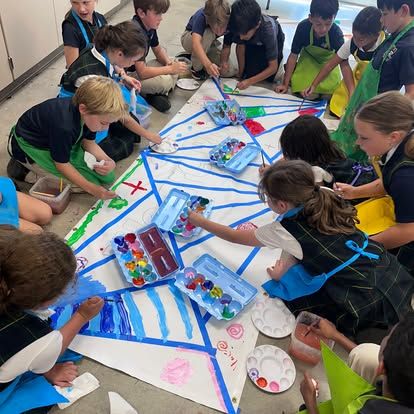
High school students created the banner designs, then younger students helped bring the shared plan to life.
That is a more meaningful form of leadership than simply receiving a title. Students must turn an idea into a workable plan, explain it to others and take responsibility for the result. They also learn that leadership is not doing everything themselves. It is helping other people contribute successfully to shared work.
Professional Habits Begin in the Classroom
Workplace readiness is also built through ordinary expectations repeated every day. In high school mathematics, for example, orderliness helps students think logically and work efficiently. Organized work makes reasoning easier to follow, errors easier to identify and corrections easier to apply.
Drafts, deadlines, prepared presentations and organized problem-solving may appear to be separate academic requirements. Together, they teach a professional pattern: prepare carefully, make your thinking visible, listen to feedback, improve the work and complete what you began.
Critical Thinking Supports Workplace Readiness
Last week’s article explored how Royalmont develops critical thinking in high school. That ability remains essential, but employers need students to do more than reach a sound conclusion. Young people must also explain their reasoning, invite useful questions, make a decision and carry the work forward with others. Critical thinking is one part of readiness; contribution is the next step.
Why Royalmont’s Approach Is Different
Some schools concentrate almost exclusively on test scores and college admission. Homeschooling can offer flexibility and close family involvement, but families may need to create regular opportunities for teamwork and public responsibility on their own. A classical program may emphasize enduring ideas and intellectual discipline. Other Catholic schools may offer a strong academic community rooted in faith.
Royalmont brings important elements together through Integral Formation: intellectual, human, spiritual and apostolic development. Students are known personally, challenged academically and formed to use their abilities in service to others. Faith is not an alternative to professional excellence. It gives excellence a purpose. The goal is a graduate who can think clearly, communicate truthfully, work responsibly and lead with Christian character.
The Decision Facing High School Parents
As enrollment season approaches, parents are not merely choosing a set of courses. They are choosing the environment that will shape how their teenager responds to responsibility, difficulty, correction and opportunity.
Families should ask: Will my student be known well enough to receive direct guidance? Will academic work require communication and collaboration, not just completion? Will my teenager have meaningful responsibilities before graduation? Will faith deepen a commitment to excellent work and service?
Parents should choose Royalmont when they want rigorous preparation joined to personal accompaniment, real responsibility and an integrated Catholic purpose. Explore the Royalmont High School program, then schedule a visit to see how students are being prepared to contribute in college, work and life.
Common Questions Parents Ask
What are soft skills in high school?
Soft skills include communication, initiative, teamwork, adaptability, problem-solving, receiving feedback and follow-through. High school students strengthen them when academic work includes real audiences, shared projects, clear expectations and meaningful responsibility.
Why do employers value soft skills?
Employers need people who can apply knowledge while working effectively with customers, managers and teammates. Technical ability may qualify someone for an opportunity, but communication, judgment and reliability often determine how well that person contributes.
Does an emphasis on soft skills weaken academics?
No. Strong soft skills help students use academic knowledge more effectively. Explaining an argument, organizing complex work, revising after feedback and collaborating on a solution all demand deeper engagement with the subject.
How does Royalmont prepare students for college and work?
Royalmont combines challenging academics with personal accompaniment, public communication, collaborative projects and everyday accountability. Through Integral Formation, students develop their intellect, character, spiritual life and ability to serve others.
Is Royalmont Academy a classical Catholic school?
Royalmont Academy offers a classically infused Catholic education grounded in the Catholic Intellectual Tradition and Regnum Christi formation. The curriculum integrates modern pedagogy while remaining faithful to Church teaching.
Discover the Royalmont Academy Difference
Imagine a school where students are known, formed, and prepared to lead — not just for college, but for life. At Royalmont Academy, we nurture academic excellence, leadership, and faith at every stage, from preschool through high school. Request information, schedule a visit, or begin your journey with us today.