
Blog

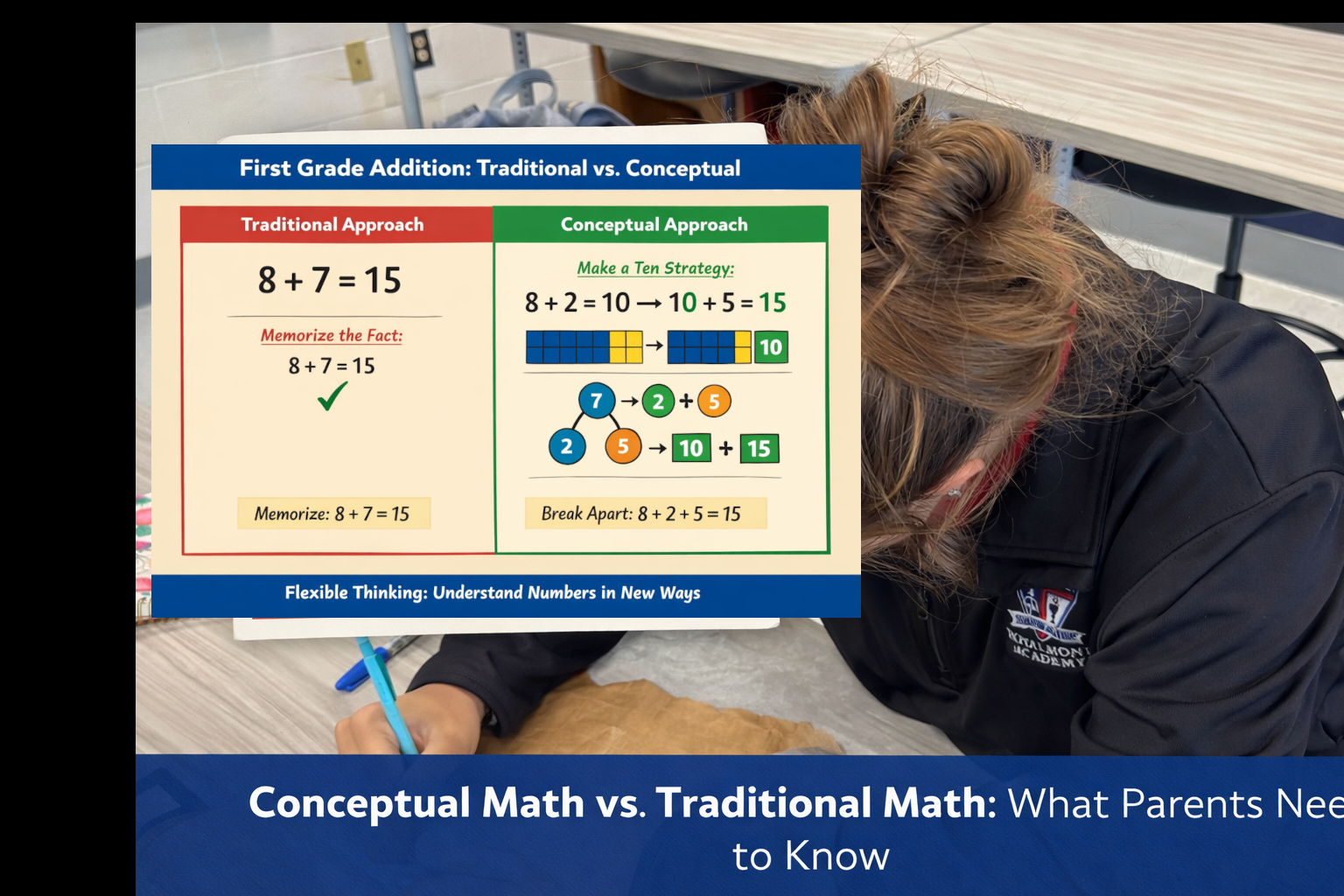
Conceptual Math vs Traditional Math: What Parents Need to Know
Many parents have asked about our shift toward conceptual math. Some have shared frustration because the homework looks different from how they learned. Others wonder if this approach is simply “Common Core” by another name.
This article explains conceptual math vs traditional math clearly, why we made the shift, and how it supports long-term student growth.
Conceptual math teaches students why a method works, not just how to follow steps.
Conceptual Math Is Not the Same as Common Core
First, it is important to clarify a common misunderstanding. Conceptual math is not a curriculum brand and it is not synonymous with Common Core.
Common Core refers to a set of state standards. Conceptual math refers to an instructional approach that emphasizes number sense, reasoning, and flexible problem-solving.
Teachers can teach conceptually with or without Common Core standards. Likewise, a school can follow standards while still relying primarily on formula memorization.
The difference lies in how students engage with mathematical thinking.
Royalmont Academy does not teach Common Core.
Traditional (Formulaic) Math: Strengths and Limits
Traditional math instruction often emphasizes memorizing formulas and following fixed procedures. For example, students might memorize the standard algorithm for long division without fully understanding why it works.
This approach builds speed and efficiency. However, when students encounter unfamiliar problems, they sometimes struggle to adapt.
Many adults learned math this way. Therefore, it feels familiar and comfortable.
Conceptual Math: Building Number Sense
Conceptual instruction focuses on understanding relationships between numbers. Instead of memorizing steps first, students explore patterns and reasoning.
Research consistently shows that students who develop strong number sense demonstrate greater flexibility in advanced math, including algebra and problem-solving.
Rather than replacing procedural fluency, conceptual math strengthens it by building deeper understanding first.
How This Looks in Real Classrooms
First Grade Example
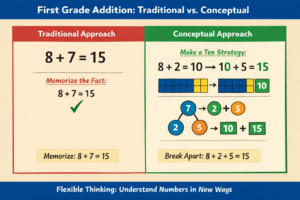
In a traditional classroom, a first grader might memorize that 8 + 7 = 15.
In a conceptual classroom, the student might break 7 into 2 and 5 to make a ten: 8 + 2 = 10, then 10 + 5 = 15.
As a result, the child learns that numbers can be decomposed and recombined flexibly. That flexibility becomes powerful later.
Fourth Grade Example
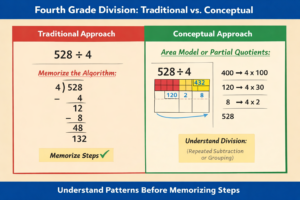
Traditionally, a fourth grader might memorize the long division algorithm.
Conceptually, the teacher first helps students understand division as repeated subtraction or grouping. Students may draw area models or partial quotients before moving to the standard algorithm.
Because they understand what division represents, they adapt more easily when numbers grow larger.
Seventh Grade Example
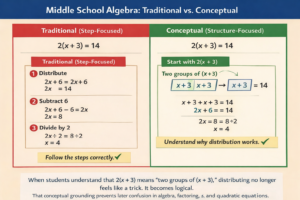
In middle school, conceptual math becomes even more important. For instance, when solving 2(x + 3) = 14, students must understand distributive property, not just follow steps mechanically.
If students previously built conceptual foundations, they can explain why distributing works instead of memorizing “FOIL” or a shortcut without context.
This depth supports long-term success in algebra and beyond.
What to Do When Math Feels Different at Home
It is completely understandable to feel frustrated when the homework looks unfamiliar. Many parents learned math through memorized procedures, so newer visual models and number strategies can feel inefficient or confusing at first.
Instead of trying to reteach the method you learned, ask your child to explain their reasoning. Questions like “Why does that work?” or “Can you show me another way?” strengthen understanding without creating conflict. If your child is stuck, reach out to the teacher for clarification rather than defaulting to a shortcut that may not match classroom instruction.
Your calm curiosity builds confidence more than speed ever will.
The Long-Term Goal: Fluent, Flexible Math Thinkers
Conceptual math is designed to form graduates who can choose the right strategy, explain their reasoning, and adapt when problems change. Those skills matter on the ACT, in college mathematics, and in real-world careers where problems rarely match a memorized template.
National research on mathematics proficiency consistently shows that true math competence includes more than correct answers. It includes conceptual understanding, procedural fluency, strategic problem-solving, and the ability to justify reasoning.
Importantly, research also shows that conceptual understanding and procedural fluency reinforce one another over time. When students understand why methods work, their speed and accuracy improve. When they practice procedures with meaning, their understanding deepens.
In other words, this is not an either-or approach. Strong math programs intentionally build understanding and fluency together because that combination produces students who succeed in algebra, higher-level math, standardized testing, and future careers.
How This Supports ACT and College Readiness
Parents naturally ask whether conceptual math helps on the ACT. The ACT Math section emphasizes algebra, multi-step reasoning, and applying mathematical structure in unfamiliar situations. Students who understand why methods work are more likely to adapt when problems change format under timed conditions.
Research consistently shows that strong conceptual understanding predicts later success in algebra, and algebra proficiency is one of the strongest indicators of ACT math performance. In other words, when students build flexible reasoning early, they are better prepared for standardized testing, college mathematics, and real-world problem solving.
Why Royalmont Uses i-Ready
At Royalmont Academy, we use the i-Ready program developed by Curriculum Associates to support both conceptual understanding and procedural fluency.
i-Ready is not just a worksheet system. It is an adaptive instructional platform that adjusts to each student’s performance level.
The program begins with a diagnostic assessment. Then, it places students on an individualized learning path that targets specific skill gaps and strengths.
Importantly, i-Ready emphasizes number sense, mathematical reasoning, and visual modeling alongside skill practice.
Our internal data show students progressing at or above expected growth benchmarks after implementing this approach.
Why This Feels Hard for Parents
When math looks unfamiliar, it can feel inefficient. Parents often say, “This seems like too many steps.”
However, those additional steps often build mental flexibility. Over time, students move more confidently and independently.
It is also difficult to help when the method differs from how you learned. That frustration is understandable.
How Parents Can Support Conceptual Math at Home
- Ask your child to explain why their method works.
- Encourage drawing or modeling when solving problems.
- Focus on reasoning, not just speed.
- Celebrate persistence when problems feel challenging.
- Don’t be afraid to ask your teacher questions.
- Find available online resources: iReady
You do not need to reteach the lesson. Instead, your curiosity and encouragement strengthen confidence.
What to Do When Math Feels Different at Home
It is completely understandable to feel frustrated when the homework looks unfamiliar. Many parents learned math through memorized procedures, so newer visual models and number strategies can feel inefficient or confusing at first.
Instead of trying to reteach the method you learned, ask your child to explain their reasoning. Questions like “Why does that work?” or “Can you show me another way?” strengthen understanding without creating conflict. If your child is stuck, reach out to the teacher for clarification rather than defaulting to a shortcut that may not match classroom instruction.
Your calm curiosity builds confidence more than speed ever will.
Common Questions Parents Ask
Is conceptual math the same as Common Core?
No. Common Core refers to state standards, while conceptual math refers to an instructional approach focused on understanding and reasoning.
Will my child still memorize math facts?
Yes. Students build procedural fluency alongside conceptual understanding. Both are necessary for long-term success.
Why does the homework look so different?
Teachers use visual models and number strategies to build deeper understanding. Those strategies may look unfamiliar but strengthen reasoning.
Does i-Ready replace classroom teaching?
No. Teachers lead instruction and use i-Ready as a targeted support tool that adapts to individual student needs.
Isn’t efficiency important? Doesn’t conceptual math slow students down?
Efficiency absolutely matters. Strong math instruction builds both conceptual understanding and procedural fluency. Conceptual learning may feel slower at first because students are building structure. However, once that structure is solid, students often solve problems more accurately and adapt more quickly when numbers or formats change.
The goal is not to replace efficiency. The goal is to build efficiency on a foundation of understanding so students can apply math confidently in algebra, standardized testing, and real-world situations.
Discover the Royalmont Academy Difference
Imagine a school where students are known, formed, and prepared to lead — not just for college, but for life. At Royalmont Academy, we nurture academic excellence, leadership, and faith at every stage, from preschool through high school. Request information, schedule a visit, or begin your journey with us today.