Blog

How Understanding Your Child’s DISC Profile Can Help at Home
Just a few weeks ago, students in grades 5–12 at Royalmont Academy received personalized DISC profile reports with their report cards. Many parents immediately asked the right question:
“Okay… what does this mean for my child at home?”
This article offers a clear introduction to how DISC helps parents understand a child’s style—without turning anyone into a “type.” In addition, it explains why Royalmont uses DISC as part of our commitment to individual accompaniment.
If you want the full walk-through of your child’s report (and practical coaching you can use right away), plan to join our Parent Formation Night. We designed that evening to go deeper than a blog ever should.
What DISC Is (And Why It Helps)
DISC is a practical framework that describes how people tend to:
- Communicate
- Respond to pressure
- Make decisions
- Relate to others
Most importantly, DISC gives parents a shared language. As a result, you can move from “Why is my child like this?” to “How do I respond wisely?”
DISC does not measure intelligence, virtue, or faith. Instead, it highlights tendencies—then invites growth.
The Four DISC Styles in Plain English
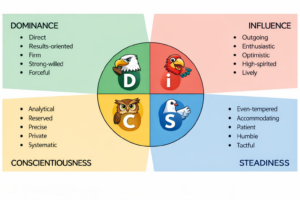
Many families remember DISC more easily through the “DISC birds” used in student-friendly materials:
- D (Dominance) – Eagle: direct, decisive, challenge-oriented
- I (Influence) – Parrot: social, expressive, enthusiastic
- S (Steadiness) – Dove: calm, steady, patient, loyal
- C (Conscientiousness) – Owl: careful, analytical, detail-oriented
Even so, most students are not “one bird.” They show a blend. In addition, their style can shift depending on stress, environment, and maturity.
If you want the school-side context of how we apply this in classrooms, read:
Understanding Your Child’s DISC Profile at Royalmont.
How DISC Helps Parents at Home
Parents often try a good strategy and then feel confused when it works with one child and fails with another. DISC helps explain why.
Below are a few simple examples to make this real. We’ll go deeper and personalize these at Parent Formation Night.
D (Eagle): “Stop Negotiating. Start Offering a Challenge.”
Many D-style kids respond best to clarity and ownership. Instead of long explanations, offer a short instruction and a meaningful choice.
Teaser example: “You can start math now and finish in 25 minutes, or you can start in 10 minutes and finish before dinner. You choose.”
I (Parrot): “Connection First. Then Correction.”
Many I-style kids engage through relationship and encouragement. As a result, they often respond better after a quick moment of connection.
Teaser example: “Talk to me for two minutes about your day first—then we’ll knock out this assignment together.”
S (Dove): “Lower the Pressure. Increase the Predictability.”
Many S-style kids dislike sudden changes and conflict. Therefore, routines and gentle consistency often work better than intensity.
Teaser example: “After snack, we do homework for 20 minutes. Then you take a break. Same plan every day.”
C (Owl): “Give the ‘Why’ and the Steps.”
Many C-style kids want accuracy and order. In addition, they often feel anxious when directions feel vague.
Teaser example: “Here are the three steps. Check each one off. Then show me your final answer.”
Important note: these are not scripts to copy and paste. They are examples of how the same parent goal can sound different depending on a child’s wiring.
Why This Matters for Formation, Not Just Behavior
At Royalmont, we use tools like DISC because we want more than compliance. We want growth.
When parents and teachers understand a student’s style, they can:
- correct with more wisdom and less friction
- motivate with greater clarity
- reduce unnecessary conflict
- form responsibility without shaming
That is individual accompaniment in real life. It respects the child’s dignity while still calling the child forward.
For a faith-aligned overview of Catholic education as integral formation, see the United States Conference of Catholic Bishops on Catholic education.
Come to Parent Formation Night to Go Deeper
This blog is designed to give you clarity. However, it cannot give you what a guided session can: translation of the reports, examples tailored to your child, and a chance to ask questions.
Join us for Parent Formation Night
In addition, if you have not looked at the school-side explanation yet, start here:
Why Royalmont Uses DISC Profiles.
Frequently Asked Questions
Is DISC a personality test that labels my child?
No. DISC is a framework that describes tendencies in communication and response to pressure. Royalmont uses it to support formation, not to limit students.
How does DISC help parents at home?
DISC helps parents adjust communication, motivation, and correction so a child can actually receive it. As a result, families often experience fewer power struggles and clearer routines.
Does DISC excuse behavior?
No. DISC helps explain tendencies, but it never removes responsibility. Instead, it helps adults correct more wisely and form stronger habits over time.
Why is Royalmont doing this now?
Because students in grades 5–12 are ready to build self-awareness and leadership skills. In addition, parents benefit when school and home share the same language for growth.
Discover the Royalmont Academy Difference
Imagine a school where students are known, formed, and prepared to lead — not just for college, but for life. At Royalmont Academy, we nurture academic excellence, leadership, and faith at every stage, from preschool through high school. Request information, schedule a visit, or begin your journey with us today.